Home / 4K IPTV Providers, and Why We Don't Rank on It
An honest page about an unverifiable claim
4K IPTV Providers, and Why We Don't Rank on It
By Daniel Carter, Provider research lead · reviewed by Sarah Mitchell · verified 14 August 2026
All eight providers ranked here advertise 4K, and none of that is verifiable from a plan page — so 4K carries no weight in our scoring. The order below is the standard ranking. What decides whether you actually see 4K is your connection sustaining 25 Mbps or more and a wired or strong 5GHz link to the television.
Figures verified against each provider's own pricing page.
Disclosure: the eight providers in this directory are operated by the network that publishes this site. That is why their plan figures here are verified against the live pricing pages rather than quoted from marketing copy — and it is why the scoring rubric is published in full, so the ranking can be checked rather than trusted. Read the full disclosure.
This page exists because people search for it, and the honest version is more useful than another list asserting that provider X has the best 4K.
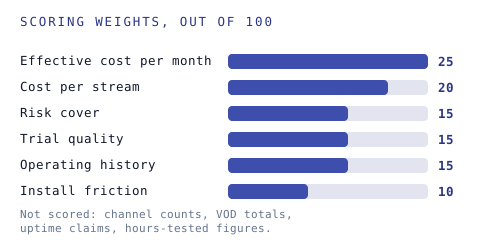
4K appears nowhere in the rubric, because no provider publishes verifiable 4K data.
Three things have to line up at once before a 4K label means anything: the provider encoding at that bitrate on the specific channel you are watching, your connection sustaining it, and the link between your router and your television carrying it. Miss any one and you get a 4K label on an HD-quality picture — and from a comparison table there is no way to tell which of the three is missing.
The standard ranking
Unchanged on this page, because no verifiable 4K input exists to change it with.
Effective cost per month 25Cost per simultaneous stream 20Risk cover 15Trial quality 15Operating history 15Install friction 10
Each score is computed from the figures in the directory. The list order is our editorial ranking, so it does not always follow the score column. Verified 14 August 2026.
Strength: The only provider that pairs the market-floor annual price with a continuous operating record going back to 2013 — the two things almost never sit together in this market.
Weakness: Publishes no refund window, and the connection ladder steps $10 at a time rather than $5.
Strength: A 30-day money-back guarantee on a $100 annual plan is the only published protection for money already paid anywhere on this site. A browser player removes the install step entirely.
Weakness: Per-device pricing is not published on the plan page — device count is chosen at checkout — so a household cannot price a multi-stream plan before starting an order.
Strength: $60 at six months and $100 at twelve are both the lowest published figures here, and the no-card trial is issued in minutes rather than hours.
Weakness: Stops at five connections, and per-stream cost stays at $10 — twice what VocoTV and KroozTV reach.
Strength: The narrowest, most regionally focused line-up on this site, which is why its programme guide holds up better on North American channels than the global panels.
Weakness: The most expensive six-month plan here at $70, and the annual plan at $110 sits $10 above the floor.
Strength: The six-month plan already costs $10 a month — identical to the twelve-month rate — so a buyer can reach the provider's floor price while committing half as much money.
Weakness: The annual plan is $120 where five providers charge $100, and per-stream cost stays at $10 on the largest plan.
Strength: Adult content is absent from the catalogue entirely rather than hidden behind a PIN, which is a design decision no other provider on this site has made.
Weakness: The trial window opens twice a week, the annual plan is $120, and six connections costs $60 a month — the widest ladder here.
During a trial, open a channel the provider labels 4K and watch a fast-moving scene. Blocking in dark areas or softness on movement means you are receiving an upscaled stream regardless of the label.
Then run a speed test on the television itself, not on a phone. If it reports under 25 Mbps sustained, the problem is your link rather than the provider — and an ethernet cable will fix more 4K complaints than switching provider ever will.
Why we do not score it
Scoring requires an input that can be checked by someone other than the seller. Channel counts fail that test, uptime percentages fail it, and 4K availability fails it too — every provider claims it, none publishes which channels carry it at what bitrate.
Including it would mean transcribing marketing copy into a score and calling the result research. The methodology page lists everything else we exclude for the same reason.
What actually correlates with picture quality
Server capacity per subscriber — which nobody publishes, but which you can feel directly at 8pm on a Sunday. That is why peak-hour testing during a trial is worth more than every 4K claim on every provider's homepage combined.
Questions people ask
Which IPTV provider has the best 4K?
Not answerable from published data. Every provider here advertises 4K and none publishes which channels carry it, so we do not rank on it.
What internet speed do I need for 4K IPTV?
25 Mbps or more sustained per stream, on a wired connection or a strong 5GHz Wi-Fi link to the television.
Is 4K IPTV worth paying more for?
There is no 4K premium to pay here — all eight charge $15 a month. If a provider charges extra for a 4K tier, ask which channels it applies to before agreeing.
Why does my 4K stream look soft?
Usually the link rather than the provider. Test on ethernet before concluding the stream is upscaled.
The bottom line
Ignore 4K claims when choosing; test 4K when trialling. The provider that holds up at 8pm is the one delivering the picture, whatever the label on the channel list says.