By Daniel Carter, Provider research lead · reviewed by Sarah Mitchell · verified 14 August 2026
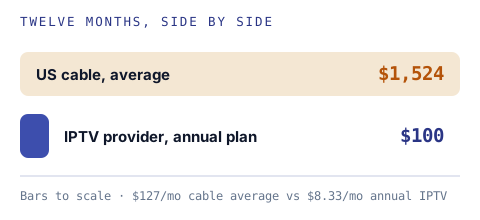
For US viewers, FreeGoTV is the best-scoring IPTV provider at 9.0 out of 10 — $100 for twelve months against an average US cable bill of about $127 a month. All eight providers here charge the same $15 monthly rate, so the term you choose moves your bill far more than the provider does.
Figures verified against each provider's own pricing page.
Disclosure: the eight providers in this directory are operated by the network that publishes this site. That is why their plan figures here are verified against the live pricing pages rather than quoted from marketing copy — and it is why the scoring rubric is published in full, so the ranking can be checked rather than trusted. Read the full disclosure.
American households are not leaving cable because streaming is fashionable. They are leaving because $127 a month buys 200 channels of which fewer than ten get watched, plus box rental, plus regional surcharges, plus a contract with an exit fee.
The arithmetic American households are running in 2026.
What a US buyer actually needs to check is narrower than the global feature lists suggest, and none of it appears on a comparison table: whether your metro's local affiliates are carried, whether the guide is accurate on US listings, and whether the stream holds between 7pm and 10pm in your own time zone.
Twelve months, itemised against cable
Same household, same year, both bills written out in full.
Strength: The only provider that pairs the market-floor annual price with a continuous operating record going back to 2013 — the two things almost never sit together in this market.
Weakness: Publishes no refund window, and the connection ladder steps $10 at a time rather than $5.
Strength: A 30-day money-back guarantee on a $100 annual plan is the only published protection for money already paid anywhere on this site. A browser player removes the install step entirely.
Weakness: Per-device pricing is not published on the plan page — device count is chosen at checkout — so a household cannot price a multi-stream plan before starting an order.
Strength: $60 at six months and $100 at twelve are both the lowest published figures here, and the no-card trial is issued in minutes rather than hours.
Weakness: Stops at five connections, and per-stream cost stays at $10 — twice what VocoTV and KroozTV reach.
Strength: The narrowest, most regionally focused line-up on this site, which is why its programme guide holds up better on North American channels than the global panels.
Weakness: The most expensive six-month plan here at $70, and the annual plan at $110 sits $10 above the floor.
Strength: The six-month plan already costs $10 a month — identical to the twelve-month rate — so a buyer can reach the provider's floor price while committing half as much money.
Weakness: The annual plan is $120 where five providers charge $100, and per-stream cost stays at $10 on the largest plan.
Strength: Adult content is absent from the catalogue entirely rather than hidden behind a PIN, which is a design decision no other provider on this site has made.
Weakness: The trial window opens twice a week, the annual plan is $120, and six connections costs $60 a month — the widest ladder here.
The three checks that decide it for a US household
Your specific local affiliates. National networks are carried everywhere; metro affiliates are where line-ups genuinely differ, and no table can answer it for your ZIP code. Confirm them during a trial.
Guide accuracy on US listings. A programme guide an hour out of sync, or blank across half the line-up, makes any channel count irrelevant.
Evening performance in your own time zone. Test between 7pm and 10pm local. Midday performance tells you nothing about how a service behaves under load.
Internet speed, and the thing that is usually actually wrong
Budget 15 to 25 Mbps sustained per HD stream and 25 Mbps or more for 4K. Almost all US broadband clears that comfortably, which is why raw speed is rarely the cause of a problem.
Wi-Fi is. A television two rooms from the router on a congested 2.4GHz band will stutter on a service that runs perfectly on a phone beside the router. Run an ethernet cable, or move the set to 5GHz, before concluding the provider is at fault.
What none of these providers can give you
A service-level guarantee. Cable will send an engineer; an IPTV provider will answer a support ticket. For $100 a year against $1,524 most cord-cutters take that trade — but it is a trade, and it is worth naming before you buy rather than after.
Questions people ask
What does IPTV cost in the USA?
$15 a month billed monthly at every provider ranked here, or $100 to $120 for a full year — an effective $8.33 to $10 a month for a single connection.
Will I get my local channels?
Coverage varies by provider and by metro area. Confirm your own affiliates during a trial rather than relying on a channel-count claim.
Is IPTV legal in the USA?
The technology is. Legality depends on whether the specific provider holds distribution rights for the content it carries.
How much can a US household save?
About $1,400 a year against the average cable bill, before counting box rental, installation and early-termination fees.
Do I need a VPN in the US?
Not for the providers here — none applies an IP lock. Some viewers use one for privacy; it is a preference rather than a requirement.
The bottom line
FreeGoTV on price and record. Whichever you pick, run the trial at 8pm on a weeknight and check your own locals before the annual plan.